This Is What Happens When You Truly See Ayutthaya
You know that moment when history stops being something you read and starts surrounding you? That’s Ayutthaya. I didn’t just visit—I felt it. Temples rising from tangled roots, monks walking silent paths, the Chao Phraya whispering stories. This isn’t just sightseeing; it’s immersion. The way light hits a broken stupa at dawn, the sound of bells fading into mist—these details transform viewing into experiencing. If you’re chasing real connection, not just checklists, Ayutthaya rewires how you see travel. It invites you to slow down, to look deeper, and to let a place reshape your understanding of time, culture, and presence. This is not a destination to be conquered, but one to be felt, frame by quiet frame.
The First Glimpse: Arrival as a Sensory Shift
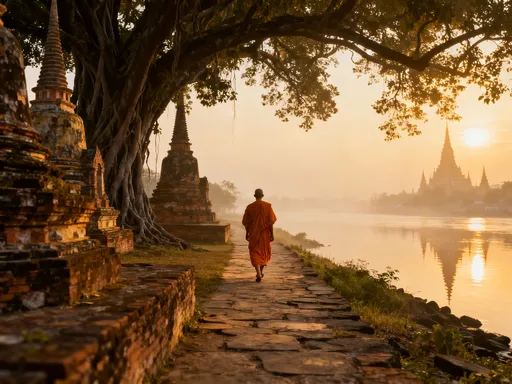
Entering Ayutthaya feels less like arriving at a tourist site and more like slipping into another rhythm of life. Whether you come by train from Bangkok, gliding past rice fields and water buffalo, or arrive by boat along the winding Chao Phraya River, the transition is immediate. The noise of the city fades, replaced by the soft crunch of bicycle tires on dusty paths and the distant chime of temple bells. The air carries a warmth that settles on the skin, mingling with the scent of frangipani and damp earth after a morning rain. You notice the light differently here—golden and diffused, filtering through a canopy of ancient banyan trees that twist around crumbling stone.
This sensory shift is not accidental. Ayutthaya, once the grand capital of the Siamese Kingdom from the 14th to the 18th century, does not announce itself with neon signs or crowded shopping plazas. Instead, it reveals itself in fragments: a weathered Buddha head nestled in tree roots, a half-standing prang silhouetted against the sky, a quiet alley where a woman sells grilled bananas from a roadside cart. The absence of urban frenzy allows space for awareness to expand. There is no rush, no pressure to see everything. The pace is set by monks walking their morning alms rounds, by children pedaling bicycles between temple grounds, by the slow turn of ceiling fans in open-air cafes.
What makes this initial experience so powerful is the contrast. After the bustle of Bangkok or even nearby Ayutthaya’s modern town center, the historical island feels suspended in time. The ancient city’s layout, built on a river delta, encourages exploration by foot or bicycle, reinforcing a slower, more intentional way of moving through space. Every turn offers a new frame: sunlight striking a weathered stupa, a heron taking flight from a moat, the shadow of a palm tree stretching across a centuries-old wall. This is where true seeing begins—not with a camera, but with presence.
Seeing Beyond Ruins: The Living Temple Experience
To view Ayutthaya’s temples as mere ruins is to miss their essence. These are not relics frozen in time but living spaces where history and daily life intertwine. At Wat Mahathat, one of the most iconic sites, the famous Buddha head entwined in tree roots draws countless visitors. Yet beyond the photo opportunity lies a deeper truth: this is still a place of worship. Monks in saffron robes walk barefoot through shaded cloisters, their chants blending with the rustle of leaves. Locals kneel on woven mats, offering lotus blossoms and joss sticks, their prayers rising with the incense smoke that clings to the stone.
Wat Phra Si Sanphet, once the royal temple with three towering chedis, tells a similar story. Though no longer an active monastery, it remains a site of reverence. Families gather at dusk, lighting candles and placing offerings at small shrines tucked beneath trees. The atmosphere is one of quiet continuity—centuries of devotion echo in every gesture. The temples are not museums but cultural anchors, preserving rituals that connect the present to the past. Even the architecture, though partially destroyed by Burmese invasions in 1767, speaks of resilience. The remaining structures, with their intricate stonework and symbolic layouts, reflect a sophisticated understanding of cosmology, power, and spirituality.
Respectful observation enhances the experience. Rather than rushing from one site to the next, taking time to sit and watch allows deeper understanding. Notice how light moves across a courtyard, how shadows lengthen as the day progresses, how the sound of a single bell can silence a crowd. Mindful photography—waiting for the right light, avoiding intrusive angles—becomes an act of reverence. When you see these spaces not as backdrops but as living environments, your perception shifts. You are no longer a spectator but a witness to an ongoing story.
Elevated Perspectives: Climbing for Clarity
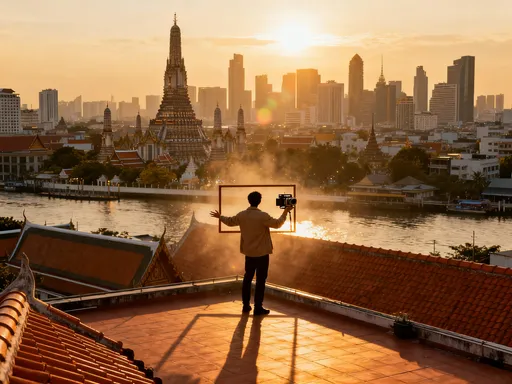
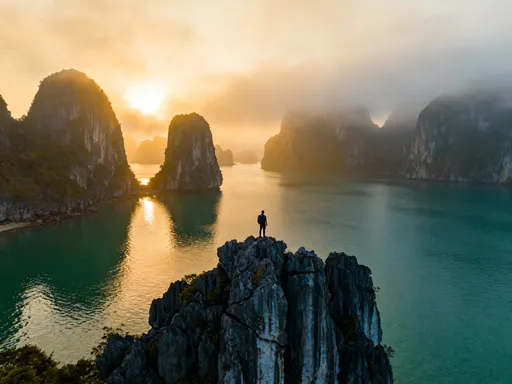
Sometimes, understanding comes not from proximity but from distance. In Ayutthaya, gaining elevation—whether by climbing a temple platform or visiting a nearby observation point—offers a new kind of insight. From above, the city’s ancient layout unfolds like a map. You begin to see the strategic placement of temples, the network of canals, the relationship between sacred and royal spaces. What appeared fragmented at ground level reveals a grand design. The symmetry, the orientation toward cardinal points, the integration with waterways—all speak to a civilization that planned with both beauty and function in mind.
The experience of climbing is itself transformative. As you ascend stone steps worn smooth by centuries, the air grows warmer, the breeze stronger. At the top, the panorama opens: a sea of green dotted with golden spires, the river curling around the island like a silver ribbon. In the early morning, mist rises from the moats, softening the edges of ruins. By midday, heat shimmers above the treetops, blurring the line between earth and sky. At golden hour, the entire city glows, the remaining stonework bathed in amber light. These changing conditions remind us that no single view is complete—each moment offers a different truth.
While not all temple platforms are open for climbing—preservation and safety are rightly prioritized—those that are accessible provide invaluable perspective. Even a modest rise can shift your understanding. You see how the temples were once connected by causeways, how the royal palace complex dominated the center, how nature has gradually reclaimed what time and war left behind. This aerial awareness fosters appreciation not just for what remains, but for the scale of what was lost. It also encourages humility: from above, the viewer becomes small, the ruins vast, time immeasurable.
The Rhythm of the River: Viewing from the Water
The Chao Phraya River is not just a geographic feature—it is the lifeblood of Ayutthaya. To view the city from the water is to understand its origins. Once a major trade hub connecting inland Siam with the Gulf of Thailand, Ayutthaya thrived because of its position at the confluence of three rivers. Even today, the river shapes the way the city is seen. A boat tour, whether on a longtail or a quiet paddle craft, offers a cinematic experience. The temples appear gradually, emerging from behind curtains of mangroves or reflecting perfectly in still water. There is a dreamlike quality to these reflections—the golden chedis inverted in the current, the sky merging with stone.
Movement on the water changes perception. Unlike walking or cycling, where you face forward, on a boat you are surrounded. Views unfold in all directions. A kingfisher dives into the water. A water buffalo stands knee-deep in a flooded field. A fisherman in a conical hat casts a net with practiced ease. These moments of daily life, framed by ancient ruins, create a layered visual narrative. The river does not separate past and present—it connects them. Along the banks, you see traditional wooden houses on stilts, children waving from docks, laundry drying in the sun. This is not a curated tourist scene but the real rhythm of riverside living.
Environmental details enrich the experience. The mangroves, with their tangled roots, provide habitat for birds and fish, their presence a sign of ecological resilience. The water level shifts with the seasons—higher and calmer during the rainy months, lower and slower in the dry season. These changes affect accessibility, with some temple entrances only reachable by boat during certain times of year. To travel by water is to accept nature’s pace, to move with the current rather than against it. It is also one of the quietest ways to experience Ayutthaya, allowing space for reflection as the city glides by.
Hidden Corners: Offbeat Spots That Rewire Perception
While the major temples draw the crowds, Ayutthaya’s quieter corners offer some of the most profound experiences. These are the places where tourism fades and discovery begins. A short pedal off the main paths reveals temples half-swallowed by jungle, their murals cracked but still visible under layers of vine. A quiet stupa, embraced by the roots of a fig tree, stands in a field where goats graze. There is no signage, no admission fee, no guidebook description—just the sense of having stumbled upon something private, almost secret.
These lesser-known sites challenge expectations. They do not offer perfect symmetry or polished restoration. Instead, they show time’s work—the slow merging of nature and architecture, the beauty of decay. A collapsed wall reveals the craftsmanship of hidden brickwork. A faded painting on a crumbling wall hints at stories lost to history. In these spaces, you begin to see differently. You notice textures: the roughness of weathered stone, the smoothness of moss-covered steps, the intricate patterns left by rain and roots. You listen more closely—the hum of insects, the rustle of leaves, the distant call of a temple gong.
Exploring these areas requires no special equipment, only curiosity and a willingness to wander. A bicycle is ideal, allowing access to narrow lanes and quiet trails. Some paths lead to local neighborhoods where life unfolds without performance—women preparing food in open kitchens, elders sitting in doorways, dogs napping in the shade. These moments of unguarded authenticity deepen the sense of connection. You are not just seeing Ayutthaya; you are moving through it, part of its daily breath. The absence of crowds allows for introspection, for a slower kind of seeing that values feeling over photographing.
Light, Time, and Transformation: How Moments Change What You See
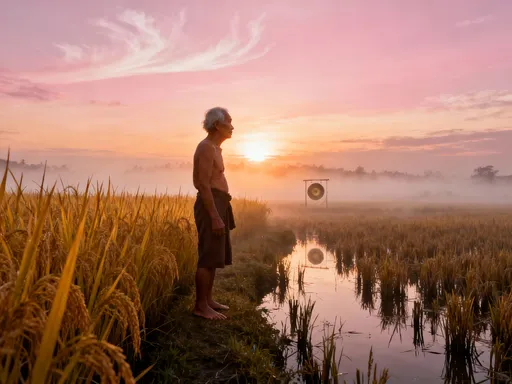
In Ayutthaya, time is not measured in hours but in light. The way a site appears changes dramatically from dawn to dusk. At sunrise, the city is bathed in soft, cool tones. Mist rises from the moats, softening the edges of ruins. The Buddha head at Wat Mahathat, often crowded by midday, sits in quiet solitude, its expression serene. This is the time for stillness, for sitting on a bench and watching the world wake. The first rays of sun strike the eastern faces of the chedis, setting them aglow, as if reigniting a forgotten fire.
By midday, the light is harsh and direct. Shadows become sharp, cutting across courtyards and stairways. Colors intensify—the green of the trees, the gold of the stupas, the red of temple banners. While less romantic, this light reveals details often missed in softer conditions: the texture of carved stone, the alignment of bricks, the wear of centuries. It is also the time when the heat slows movement, encouraging rest. Locals retreat to shaded porches, sipping iced tea. Visitors find refuge under wide-brimmed hats and umbrella trees. This pause, though born of discomfort, becomes part of the rhythm—a reminder that not every moment must be filled with action.
As the sun lowers, Ayutthaya transforms again. Golden hour wraps the city in warmth. The stone seems to breathe light, radiating the day’s heat. Reflections in the river deepen, turning water into liquid gold. This is when photography thrives, but also when seeing becomes most personal. The fading light invites contemplation. You may find yourself returning to a site you visited earlier, seeing it anew. This practice—waiting, returning, re-seeing—teaches patience, a quality often missing in modern travel. Seasonal changes add another layer. During the rainy season, lush vegetation softens the ruins, water fills the moats, and the air hums with life. In the dry season, the earth cracks, the river shrinks, and the bones of the city stand more exposed. Each season offers a different face of Ayutthaya, reminding us that nothing is fixed, nothing permanent.
Carrying the View Forward: From Observation to Reflection
Leaving Ayutthaya, you carry more than photos. You carry a shift in perception. The city does not just show you its past; it teaches you how to see. The practice of slow, intentional viewing—of noticing light, listening to silence, respecting sacred spaces—extends far beyond this island capital. It becomes a lens for all travel, and perhaps for life itself. You begin to question the rush, the checklist mentality, the need to capture rather than experience. Ayutthaya invites you to linger, to return, to sit with uncertainty, to find meaning in what is broken as well as what is whole.
This is the quiet wisdom of ruins. They do not boast of their former glory but stand as quiet teachers of impermanence. The temples, cracked and weathered, remind us that all things change. The trees growing through stone show how life reclaims what is abandoned. The monks walking their daily rounds demonstrate continuity amidst decay. These are not lessons delivered in words but felt in the body, absorbed through the eyes, carried in the heart. For women in their thirties to fifties—mothers, caregivers, planners—this kind of travel offers rare permission: to pause, to reflect, to reconnect with a sense of wonder that daily routines often bury.
So let Ayutthaya be more than a destination. Let it be a practice. The next time you travel, resist the urge to see everything. Choose one temple, one path, one moment. Sit with it. Return to it. Watch how it changes with the light. Let go of the need to document and open to the act of truly seeing. In doing so, you honor not just the place, but yourself. Because in the quiet spaces between ruins and river, between past and present, you may find something unexpected: a deeper awareness of where you stand, and who you are becoming. That is the real journey. That is what happens when you truly see.